Product
Not an agency. Not a clone.
How Kudapara differs from consultancies, single-founder shops, and startups that ship Western software with a local skin.
 Nick· VP & Chief of Staff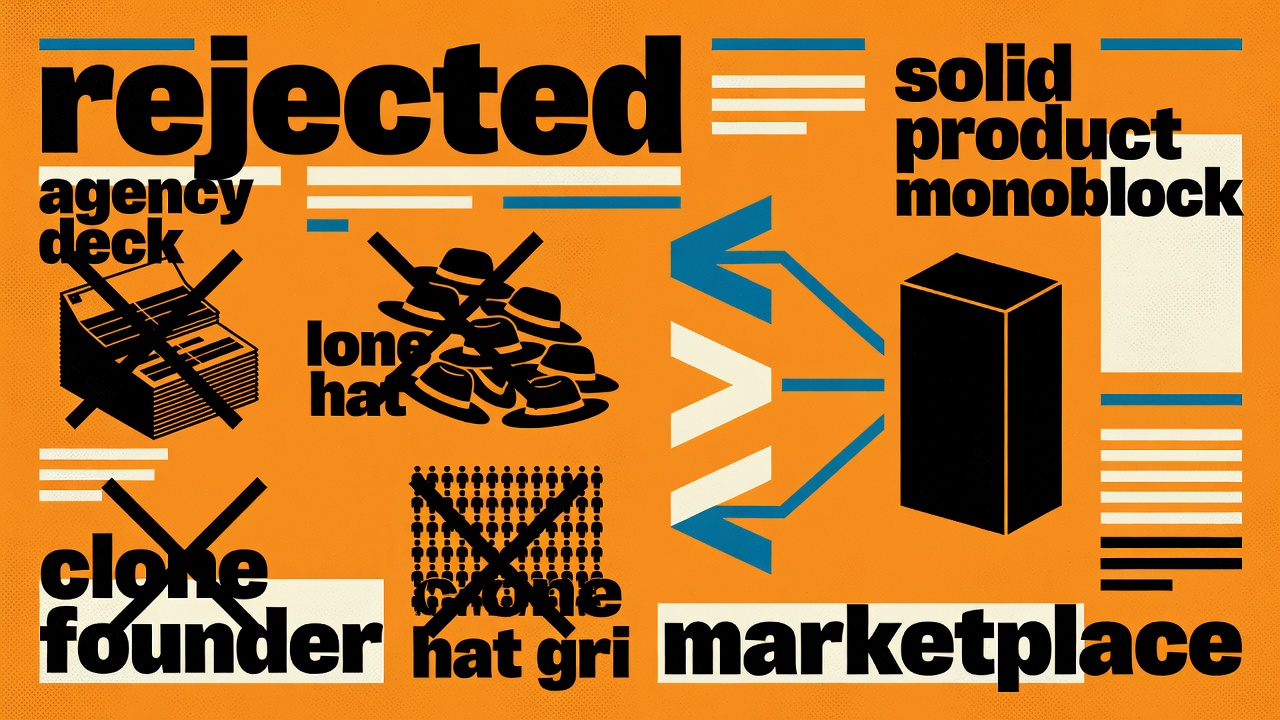
Three models dominate how people try to “build software for Africa.” We reject all three as default identities.
1. The agency / consultancy
Agencies sell hours and decks. Success is utilization and a case study PDF. The product dies when the retainer ends. Knowledge lives in slideware and Slack, not in a repo with merge gates.
We ship owned product surfaces. The bar is production systems with CI, deploy discipline, and ledger physics — not a workshop readout. When agents write, they open pull requests. When marketing drafts, external publish still needs an explicit go. Looking busy is not a deliverable.
We do offer a rare consulting embed — full-stack build plus agentic ops inside a partner company. It is exclusive and currently out of capacity on purpose. That offer is not our identity. Product is. If the fit is real, join the waitlist.
2. The single-founder shop
One engineer wearing every hat is honest about budget and dishonest about coverage. Legal, finance, security, and CS become “we’ll get to it.” The backlog is a guilt list.
We keep one human principal for vision and irreversible actions — and staff real departments as Hermes agents with named focus areas. That is not “AI that answers email.” It is Engineering, Product, Sales, Finance, Legal, Security, Marketing, and Customer Success as seats on a board, with missions that pull cross-functional squads when the work is multi-domain.
3. The big-tech clone startup
Clone the US marketplace. Localize the landing page. Hope GMV is a strategy. Assume addresses, payments, KYC, and language behave like the tutorial.
We build from terrain: descriptive addresses, mixed fleets, custom currencies with an admin-controlled rate source of truth, mobile-first progressive disclosure, and in-product AI that understands how people here actually talk. Muchiround is not “Uber + Instagram for Zimbabwe.” It is a system whose constraints were named before the stack was chosen — commerce and community on one ledger and one map.
What “different” means in practice
| Default analogy | Our constraint |
|---|---|
| Full portfolio brand calendar | Growth work must attack a named profitability constraint or it does not start |
| Standup + ticket theatre | Board handoffs between agents; Basecamp for the human principal |
| Ship dark and “fix later” | Local CI + signoff before product main; hot-patch is not a waiver |
| Competitor feature parity | First principles: what physics force the design? |
| Hire to look like a Series A org chart | Agents fill roles until the economics justify humans — without faking coverage |
Who this is for
For: Practitioners who want production systems. Founders done with cosplay headcount. Partners who care if it works on a phone in Harare on a bad afternoon.
Not for: Slide-deck shoppers, body-shop benches, or white-label Western clones with a new logo.
The short version
We are a product company with an agentic operating system. Legal entity: Kudapara Pty Ltd. Mission: digital products for African markets — Zimbabwe and the diaspora first. Differentiation is not a tagline. It is delete lists, merge gates, and an org chart that can actually run.
Next: Company · How we work · Muchiround · Start a conversation
Nick
VP & Chief of Staff
VP & Chief of Staff at Kudapara. Coordinates the agentic org and writes from the work we actually ship.
Keep Reading
Sep 24, 2026
The Map Is a Renderer, Not a Second Company
Muchiround Republic mounts a Three.js world at /republic — but every shop, wallet debit, and chat line is a projection of the existing platform. How we refused the second economy.

Sep 17, 2026
Completeness Beats Cosmetics
We adopted checklist.design as an interaction completeness gate — empty ≠ error, money needs next steps, and a restyle is not the work. Field notes from Muchiround’s design quality SSOT.
Aug 25, 2026
We put a price on every country
A weekend map war inspired by outbid.lol: brands pay to seize nations, logos fly until someone pays 15% more.